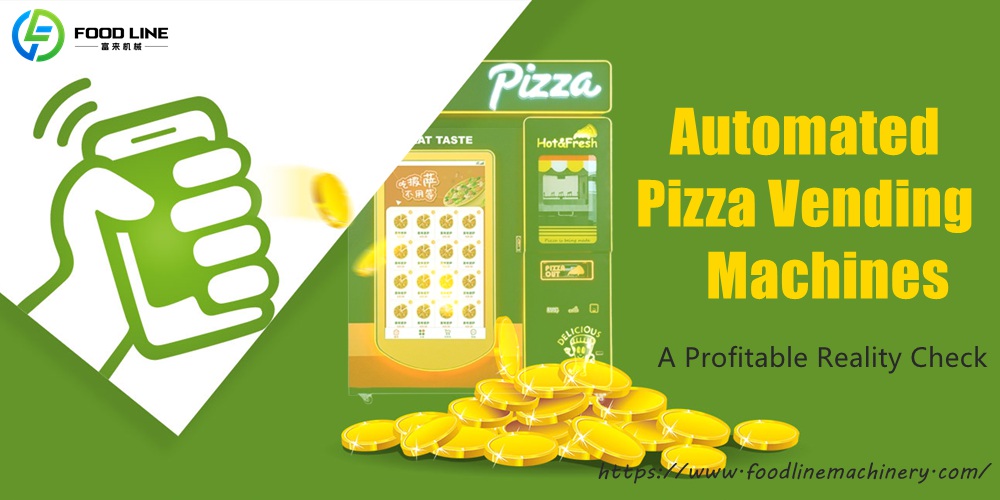
The automated pizza vending machine has been called everything from “the future of fast food” to “an overhyped gimmick.” After years of pilot runs, burnt crusts, and viral complaints, it’s time for a more honest conversation.
Yes, there are real problems. But yes, there is also real money to be made.
As a leading Chinese manufacturer, Foodline has built hundreds of machines now operating across Europe, Southeast Asia, and the Middle East. We have seen the failures. We have also seen the successes. This article is not another promotional brochure. It is a clear-eyed look at what actually works, what still doesn’t, and why — despite the challenges — investing in a pizza vending machine can be a highly profitable business.
Let’s address the elephant in the room. Early-generation pizza vending machines earned a bad reputation for a reason.
1. Inconsistent Baking Results
The single biggest complaint from real users is uneven cooking — burnt edges, undercooked centers, or cheese that hasn’t fully melted. This happens when the transition from -18°C frozen storage to 300°C baking is poorly managed. Thermal shock is real, and cheap components make it worse.
How Foodline fixed this: We use dual heating systems (microwave pre-heat + forced-air convection) with real-time infrared temperature sensors. The result is a consistently golden crust and fully melted cheese in under 3 minutes.
2. Mechanical Reliability
Operating a robotic arm across a temperature difference of over 300°C is mechanically brutal. Bearings wear out. Sensors drift. Pizzas get stuck. In the worst cases, machines go offline for weeks while waiting for expensive technician visits.
How Foodline fixed this: We over-engineer the moving parts. Our linear guides and bearings are rated for extreme thermal cycling. We also design for modular repair — a failed component can be swapped in 15 minutes by a local technician, not a factory engineer.
3. Limited Menu Variety
Another common user complaint: “There are only three flavors, and my favorite is always sold out.” This isn’t just a nuisance — it’s lost revenue.
How Foodline fixed this: Our machines hold up to 70 pizzas across 20+ varieties. The intelligent inventory system tracks sales by time of day and automatically suggests restock priorities to the operator. Breakfast pizzas? Dessert pizzas? The system handles them all.
4. The “Taste Gap” vs. Artisan Pizzerias
Let’s be completely honest: no machine today can replicate a wood-fired, hand-tossed pizza made by a third-generation Neapolitan pizzaiolo. If that’s your benchmark, you will be disappointed.
But that’s also the wrong benchmark. The relevant comparison is not to a $25 artisan pizza. It’s to a gas station sandwich, a cold vending machine burrito, or a 2 a.m. instant noodle cup. Against those, a properly executed machine pizza wins every time.
The Profitability Case: Why It Still Makes Excellent Business Sense
Problems acknowledged. Now let’s talk about money.
With numbers like these, a single Foodline machine can pay for itself in 8 to 14 months — faster if placed in a high-traffic location. After that, it becomes pure profit generation.
Why the Margins Are So Attractive
No labor cost per transaction — The machine works 24/7 without wages, benefits, or shift scheduling.
No rent for a full kitchen — A 2-square-meter footprint can go where a restaurant never could.
Low ingredient cost — Frozen par-baked crusts, shelf-stable sauces, and vacuum-sealed toppings have long shelf lives and minimal waste.
Cashless + high average ticket — A $8–$10 pizza generates far more revenue per transaction than a $1.50 soda or $2 candy bar.
Where Machines Actually Thrive (And Where They Fail)
Based on real deployment data from Foodline’s existing customers, we can draw clear lines.
Profitable Locations
Universities & dormitories — Students want hot food at odd hours. 11 p.m. to 2 a.m. is peak revenue time.
Hospitals & medical centers — Visitors and staff have limited options, especially overnight.
Factories & industrial parks — Shift workers have set break times and appreciate a hot meal without walking far.
Highway service stations — Travelers want speed and convenience. A 3-minute pizza beats a 20-minute wait.
Residential neighborhoods without foot traffic — The machine will not draw people to a dead zone.
Directly next to a Dominos or Pizza Hut — You will lose on taste comparison and brand loyalty.
Low-income areas where $8 is considered expensive — Know your local economics.
The Investor’s Checklist: How to Succeed
Buying a machine is easy. Making money from it requires attention to four things.
1. Site Selection Is 80% of the Equation
Spend more time evaluating locations than comparing machine specs. Count foot traffic at different hours. Observe competitors. If possible, run a short-term pilot with a single machine before scaling.
2. Master the Restocking Routine
A machine is only as good as its supply chain. You need a reliable source of frozen par-baked pizzas (Foodline can provide supplier introductions), a simple cleaning protocol, and a restocking schedule that prevents popular flavors from running out. This takes about 30 minutes per day per machine.
3. Set the Right Price Point
Too high, and customers will walk. Too low, and you leave money on the table. Test and adjust. In most markets, $6–$8 for a 9-inch pizza and $9–$12 for a 12-inch pizza hits the sweet spot.
4. Embrace Transparency with Customers
Consider adding a small sign next to the machine: “Freshly baked in 3 minutes. Not artisan — but hot, convenient, and consistent.” Managing expectations reduces bad reviews.
The Bottom Line: A Mature Opportunity, Not a Get-Rich-Quick Scheme
Automated pizza vending is no longer a science experiment. The technology has matured. The failures of early machines have been studied and corrected. And the business model has proven itself across thousands of installations worldwide.
But it is not passive income. Successful operators treat it as a real business — managing locations, monitoring inventory, and caring about product quality.
For investors who are willing to do that work, the returns are compelling. A well-placed Foodline machine generates $4,000–$7,000 of net monthly profit, pays for itself within a year, and then continues printing cash for years to come.
And for the skeptics who still remember the burnt pizzas of 2019? Come take a test bake at our facility. We’ll let the crust speak for itself.
About Foodline
Foodline is a leading Chinese manufacturer of automated pizza vending machines, with hundreds of units deployed globally. We combine German-engineered components, intelligent software, and hands-on operator support to deliver machines that work — and make money — every day. OEM, customization, and distributor inquiries are welcome.