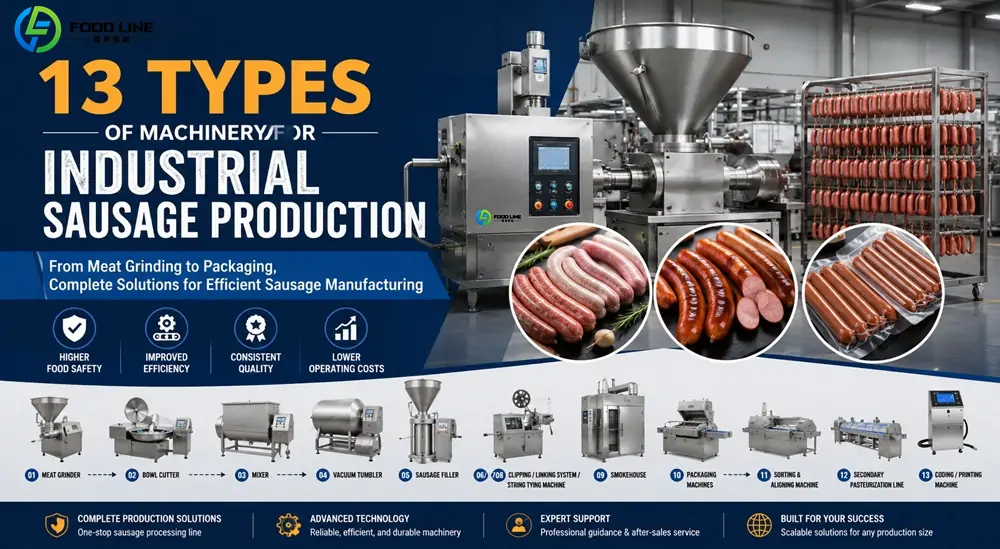
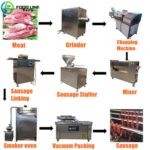
Industrial sausage production involves multiple processing stages, from meat grinding and mixing to stuffing, cooking, packaging, and coding. Choosing the right sausage processing machinery helps improve product consistency, production efficiency, food safety, and overall operating costs.
A high-quality meat grinder prepares uniform meat particles while minimizing heat generation and meat damage.
Function: The meat grinder cuts large pieces of meat into smaller particles.
Working Principle: A screw conveyor pushes the meat through a barrel with guide ribs. The meat is then forced through a perforated plate, also called a die plate. Rotating blades cut the meat into smaller particles.
Standard and customized die plates are available. Hole diameters typically range from 3 mm to 32 mm.
Key Quality Indicator: Although the structure looks simple, producing a high-performance grinder is technically demanding. Concentricity and guide-rib design are especially important.
One of the most important performance indicators is the temperature difference between the meat before and after grinding. A smaller temperature increase means less damage to the meat. Ideally, the temperature difference should remain within 2°C.
Specialized Type: Some grinders include a separation unit for removing connective tissues such as tendons and sinews. These machines are commonly known as tendon-removing grinders.
Industry Insight: The grinder is considered one of the most important machines by some sausage manufacturers. A good grinder produces clear, separate meat particles, even when processing fatty tissue. This indicates lower mechanical damage and better processing performance.
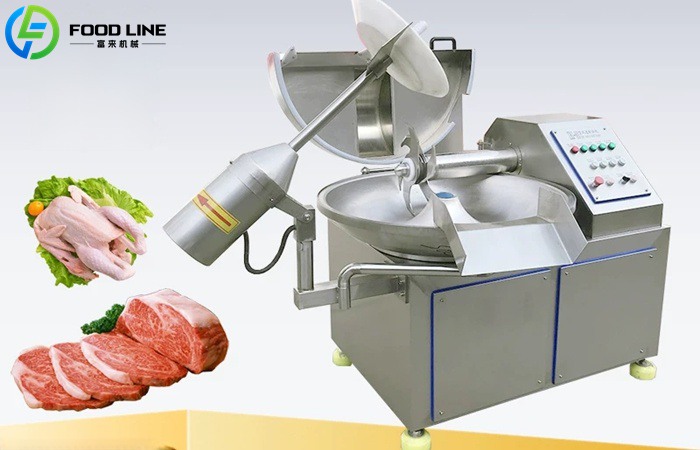
02. Bowl Cutter (Chopper/Emulsifier)
A bowl cutter efficiently extracts salt-soluble proteins and creates the stable meat batter needed for many sausage products.
The bowl cutter plays a key role in extracting salt-soluble proteins from sausage batter. These proteins combine with water in the raw materials to form a gel at approximately 2–8°C. This process creates a viscous and stable emulsion.
Working Principle: Six blades are mounted on a high-speed shaft. As the bowl rotates at an adjustable speed, the blades rapidly chop and emulsify the meat.
Performance: High-end bowl cutters can achieve salt-soluble protein extraction rates of up to 68%. This level of extraction is difficult to achieve with other sausage processing equipment.
Additional Role: The bowl cutter also helps reduce production costs and improve flavor. It can efficiently emulsify pork skin, chicken skin, and meat trimmings that are difficult to process with a grinder.
For example, chicken skin emulsion can be added to Taiwan-style sausages. This can help reduce raw material costs while enhancing flavor and texture.
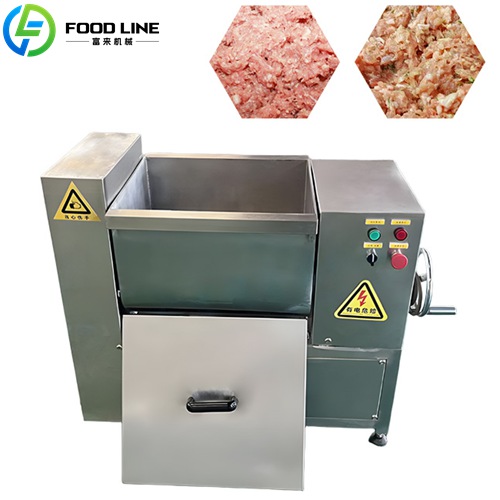
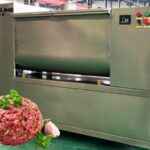
03. Meat Mixer (Blender)
A sausage mixer ensures that meat, water, and auxiliary ingredients are evenly distributed for consistent flavor, texture, and structure.
The mixer is a traditional and relatively simple machine. It thoroughly blends finely chopped raw materials with water and other ingredients.
The resulting mixture is then prepared for the next production stage.
Application: Although simple, the mixer remains essential for many traditional sausage products. It helps preserve their established flavor, structure, and texture.
Typical applications include Harbin red sausage, Krakowska, Smoked sausage, Tea Sausage, and SPAM luncheon meat.
For these traditional recipes, changing the processing method can affect the final product. For example, replacing the traditional mixing process with a bowl cutter may change the sausage’s characteristic texture and flavor.
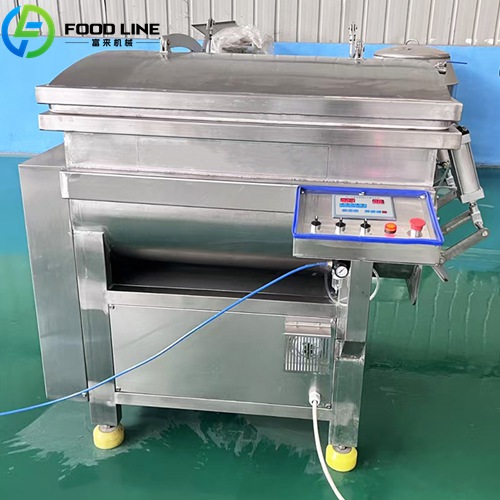
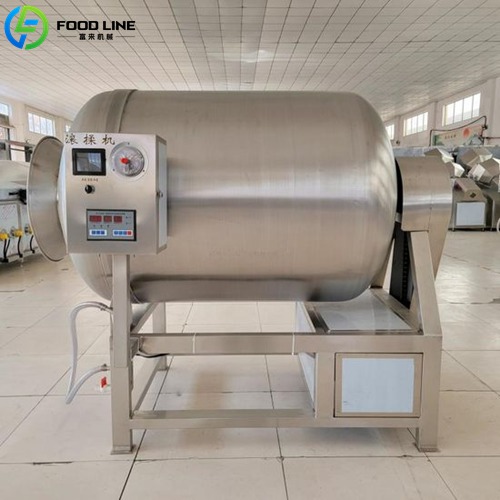
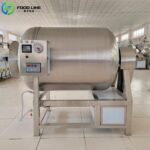
04. Vacuum Tumbler (Massager)
A vacuum tumbler machine accelerates curing and improves the uniform absorption of brine, water, and seasonings.
Tumbling is essentially a curing process. However, it is much faster than static curing. For this reason, it is often called dynamic curing.
Working Principle: Under vacuum conditions, the meat tissue expands inside the tumbler drum. This creates better conditions for brine, water, and seasonings to penetrate the meat.
The result is more even seasoning and faster curing.
Designs: Vacuum tumblers are available in different models. Their structures are mainly divided into two types:
Welded-rib design: Ribs are welded directly onto the drum wall. This design is common in hydraulic 750 L tumblers.
Baffle-plate design: A built-in baffle plate helps with product discharge. This design is common in 1,500 L and 2,500 L “breathing” type tumblers.
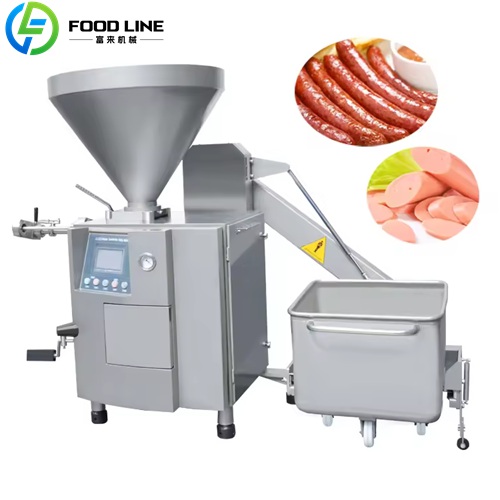
05. Sausage Filler (Stuffing Machine)
A sausage filler provides accurate and consistent filling, helping manufacturers achieve uniform sausage weight and appearance.
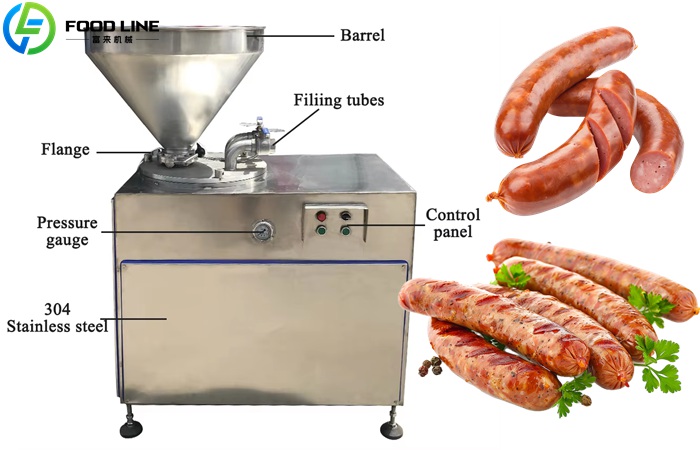
The sausage filler is used to fill casings with prepared meat batter.
Common types include:
Pneumatic sausage stuffers
Hydraulic sausage stuffers
Electric sausage stuffers
Vacuum quantitative stuffers
Non-vacuum quantitative stuffers
General-purpose sausage stuffers
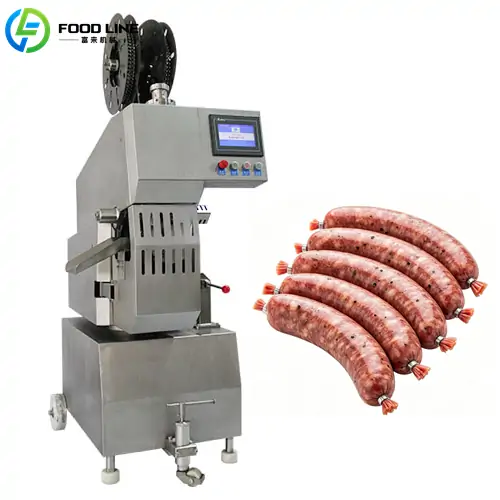
For high-volume production, vacuum continuous filling and linking machines are available. These systems can continuously fill and link sausages, reducing manual labor and improving production efficiency.
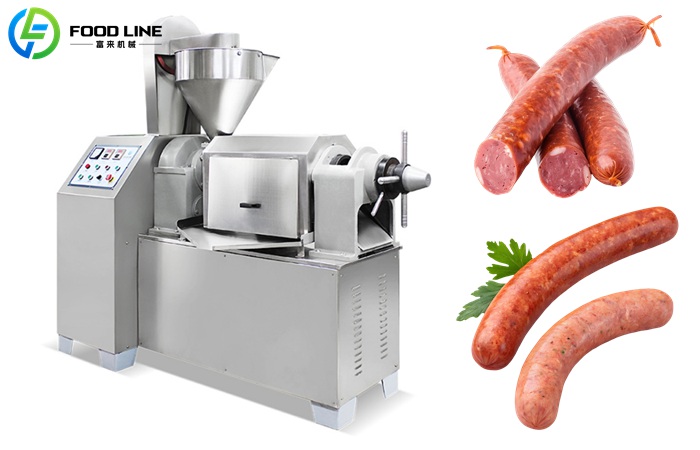
Electric sausage stuffers
Sausage Stuffer (Filling Machine)
06. Clipping Machine (Clipper)
A clipping machine provides fast, secure sealing for large-diameter sausage casings.
The machine is mainly designed for sealing large-diameter, thick-walled casings.
Suitable casing materials include:
Nylon casings
Fibrous casings
Fibrous-coated casings
Large-diameter inedible collagen casings
It is particularly useful for sausage products that require strong and reliable casing closure.
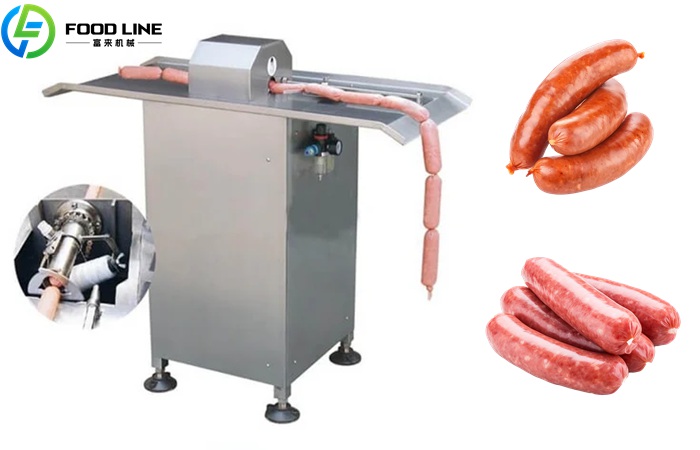
07. Linking System (Twister)
A sausage linking system quickly divides small-diameter sausages into individual links for high-speed production.
The linking system is mainly used for small-diameter sausages.
Instead of using separate tying materials, the machine twists the casing itself to create individual sausage links.
Its main advantage is high operating speed. This makes it suitable for manufacturers looking for high production efficiency and continuous sausage processing.
08. String Tying Machine (Linking Machine)
A sausage string tying machine can reduce casing consumption and labor requirements while maintaining efficient sausage linking.
Key Advantages:
Saves Casing: The machine can save approximately 350–1,200 tons of casing.
Saves Labor: Operating speeds can reach 200–240 links/min. .
Automatic Cutting: The cut-on-the-fly function allows automatic sausage cutting during continuous production. It can effectively replace manual cutting and can match or exceed the speed of high-speed sausage shears.
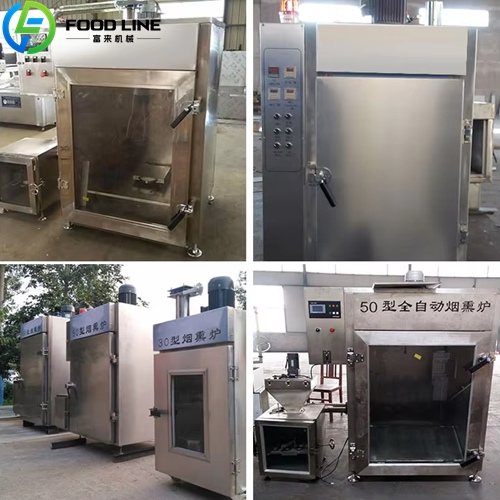
09. Smokehouse (Cooking/Smoking System)
An automated smokehouse provides precise control over cooking, smoking, drying, temperature, and humidity for consistent sausage quality.
Most meat processing plants use automated smokehouses. Computerized controls manage time, temperature, and humidity throughout the process.
Available configurations include:
Single-door smokehouses
Double-door smokehouses
Single-truck systems
Multi-truck systems
Heat Supply Methods
1. Steam Heating
Steam is the most common heating method. It normally requires two separate steam lines:
High-pressure steam: 0.6–0.8 MPa Mainly used for drying and hot-smoking processes.
Low-pressure steam: below 0.1 MPa Mainly used for cooking. For thin and delicate collagen casings, the pressure should be below 0.07 MPa to reduce the risk of casing bursts.
Heat Exchanger Designs: Two common designs are available.
One uses individual heating coils. For example, a 2-door/4-truck smokehouse may use four separate coils.
The other uses an integrated evaporator-type heating unit. This design heats faster and is easier to disassemble, but it generally has higher manufacturing costs.
2. Electric Heating
All-electric smokehouses are suitable for factories located near urban areas where coal-fired boilers are restricted or prohibited.
Heating: Electric heating tubes are installed on the ceiling. Power consumption is typically around 25 kW per unit, with each unit corresponding to one truck.
Steam Generation: Unlike steam-heated systems, all-electric smokehouses do not require a separate steam supply.
Instead, a pressurized water line sprays a fine water mist onto electric heating tubes. The tubes can reach approximately 400°C, instantly converting the water into steam.
This process can achieve 100% humidity during cooking.
10. Packaging Machines
Sausage packaging machines protect the finished product, extend shelf life, improve presentation, and support efficient downstream processing.
Industrial sausage production can use several packaging technologies.
(1) Impulse Sealer
Impulse sealers are simple heat-sealing machines. They can be operated by hand or foot.
For higher production efficiency, continuous band sealers are also available. These are commonly used for standard non-vacuum packaging.
(2) Chamber Vacuum Packager
Chamber vacuum packagers are available in single-chamber and double-chamber models.
Double-chamber machines are more common in higher-output operations because they can improve working efficiency.
Performance depends heavily on the vacuum pump and control method. Common vacuum control options include continuous vacuum and pulsed vacuum.
These machines are suitable for sealing laminated plastic bags.
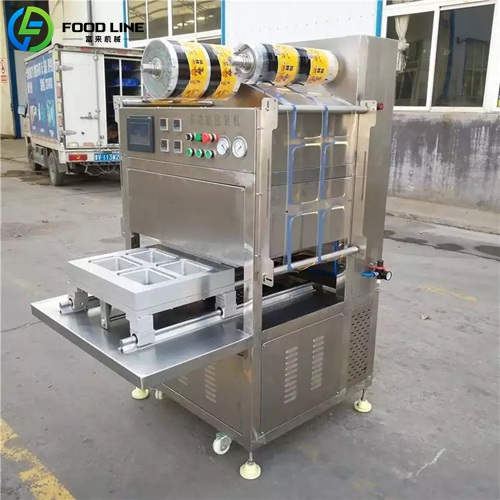
(3) Thermoforming (Rollstock) Vacuum Packager
Also called a continuous vacuum stretch packager, this machine uses upper and lower film rolls.
The lower film is generally thicker and wider.
A thermoforming vacuum packager can integrate multiple processes into one production line, including:
Heating
Forming
Vacuum sealing
Conveying
Cutting
Labeling
Date printing
Perforating
This integrated design can reduce manual handling and improve packaging efficiency.
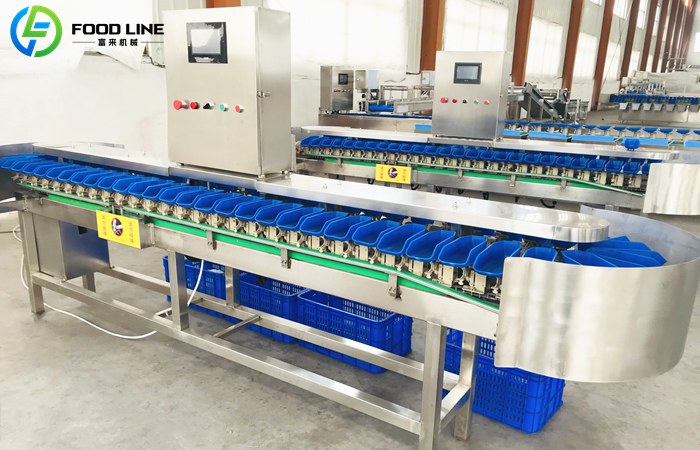
The machine automatically sorts sausages according to size. Products that do not meet the required specifications can be rejected.
The system then aligns sausages with uniform lengths. It can also automatically place the required number of sausages into pre-formed trays.
The trays are then transferred to the packaging machine for further processing.
Automatic Fruit and Vegetable Grading Machine
12. Secondary Pasteurization Line
Core Value: Secondary pasteurization helps reduce post-processing contamination and can extend the shelf life of packaged sausage products.
A secondary pasteurization line typically consists of:
Hot water tanks
Cold water tanks
Cooling sections
Air dryers
Continuous conveyors
Electronic control systems
After packaging, the products pass through the pasteurization process. This provides an additional treatment step designed to reduce contamination introduced after the primary processing stages.
The process can help improve product hygiene and extend shelf life when properly integrated with the overall food safety system.
13. Coding/Printing Machine (Inkjet Printer)
Core Value: A coding and printing machine provides clear production information and supports product traceability.
Inkjet printers are commonly used to print production dates, batch information, and barcodes on packaged sausage products.
They are often installed after simple sealing or chamber vacuum packaging systems.
Advanced thermoforming vacuum packagers usually include an integrated coding function. This reduces the need for a separate coding machine and creates a more streamlined packaging process.
Choosing Right Sausage Processing Machinery
When comparing sausage processing machinery, you should look beyond machine price. Consider processing performance, product quality, capacity, automation level, food-contact materials, maintenance requirements, energy consumption, and after-sales support.
The right combination of sausage processing machines can create a more efficient, consistent, and scalable production line—from raw meat preparation to final packaging.
Foodline Machinery can provide all these machines for your industrial sausage production. Leave your message and get a custom solution.
Edith is a seasoned food machinery industry professional with over 10 years of hands-on experience in food processing equipment research, factory website operation, and technical content creation.