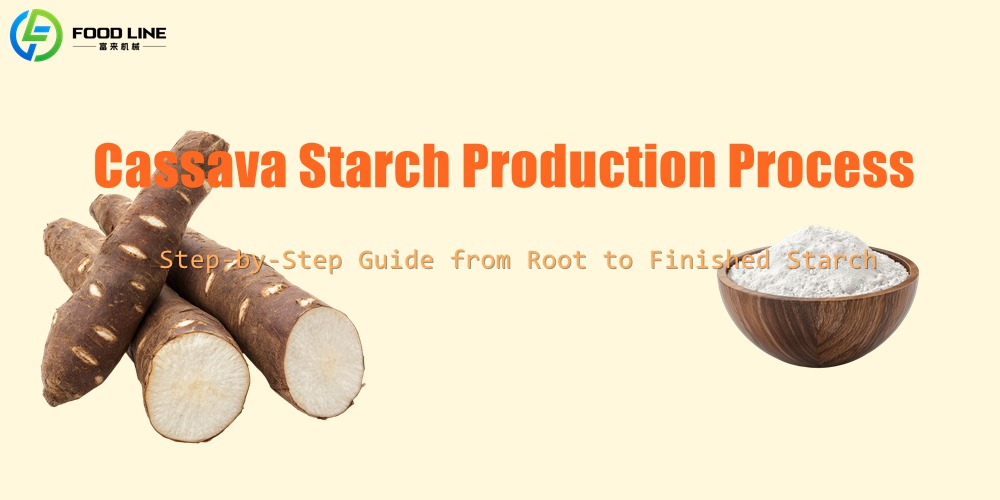
Tapioca starch is a powder produced by extracting starch from cassava and then dehydrating and drying it. It is commonly used to make desserts such as puddings, bobas, and taro balls, and is also the raw material for the sago pearls found in sago soup. But do you know how is made the tapioca starch? Here we will present the complete cassava starch production process.
Cassava starch is primarily produced using the wet processing method. This process takes advantage of two key characteristics of starch:
Starch is insoluble in water
Starch particles are heavier than water
By using water as the separation medium, starch can be efficiently extracted, purified, dewatered, and dried from fresh cassava roots.
The entire production process consists of four main stages:
Raw Material Preparation
Crushing and Starch Extraction
Purification and Refining
Dewatering and Drying
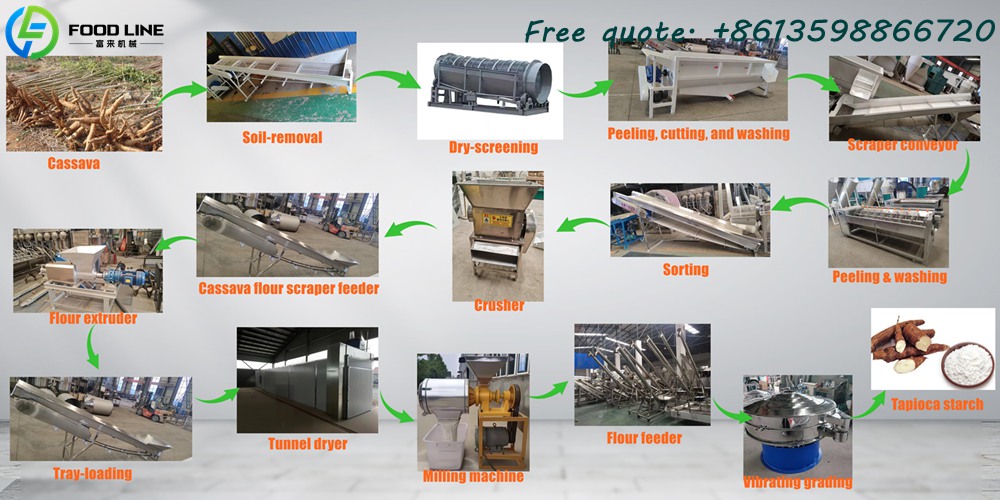
Cassava Starch Production Flow
The cassava starch production process includes cleaning, crushing,
separation, refining, dewatering, drying, and packaging to produce
high-quality tapioca starch.
Fresh Cassava Roots
→
Cleaning
Drum Washer
→
Crushing
Rasper / Hammer Mill
→
Centrifugal Sieve
→
Desander
→
Disc Separator
→
Dewatering
Vacuum Filter / Peeler Centrifuge
→
Drying
Flash Dryer
→
Starch Packaging
How to produce cassava starch from cassava?
Step 1: Raw Material Preparation
The quality of cassava starch begins with the quality of the fresh cassava roots. To achieve maximum starch yield and product quality, cassava should ideally be harvested, delivered, and processed on the same day.
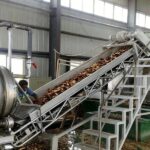
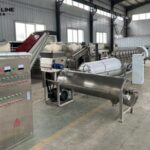
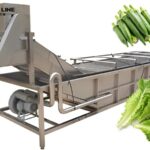
Fresh cassava is first fed into a drum washing machine, where high-pressure water removes soil, sand, stones, roots, and other impurities. During this stage, a large portion of the cassava peel is also removed. Effective peeling is important because cassava peels contain cyanogenic compounds that can affect starch quality and safety.
Main Equipment
Drum Washing Machine
Cassava Peeling System (optional)
Step 2: Crushing and Starch Release
After cleaning, the cassava roots are sent to a rasper or hammer mill for crushing.
The high-speed grinding action completely breaks down the cassava cell structure, releasing the starch granules and forming a starch slurry. Efficient crushing is critical because it directly affects starch extraction efficiency and final yield.
Main Equipment
Cassava Rasper
Hammer Mill
Step 3: Separation and Refining
This is the most important stage of cassava starch production. Multiple separation systems work together to remove fiber, sand, protein, and other impurities.
1. Fiber Separation
The starch slurry passes through a centrifugal sieve, where starch milk is separated from coarse fiber. Counter-current washing helps recover residual starch from the fiber residue, maximizing starch yield.
2. Sand Removal
The extracted starch milk then enters a desander, which removes fine sand and heavy impurities using centrifugal force.
3. Concentration and Purification
The purified starch milk is processed by a disc separator, which separates starch from protein and other soluble impurities based on differences in specific gravity.
Multiple disc separators are often arranged in series with counter-current washing to achieve higher starch purity and whiteness.
Main Equipment
Centrifugal Sieve
Desander
Disc Separator
Step 4: Dewatering and Drying
The refined starch milk still contains a significant amount of water. It is first mechanically dewatered using a:
Peeler Centrifuge, or
Vacuum Filter
This reduces the moisture content to approximately 40%.
The wet starch is then conveyed to a flash dryer (airflow dryer). Inside the dryer, the starch is suspended in a stream of hot air and dried almost instantly.
The final starch moisture content is typically controlled at 12–14%, making it suitable for storage, transportation, and packaging.
Key Factors for High-Quality Cassava Starch Production
Fresh Cassava Is Essential
Freshly harvested cassava provides higher starch yield, better whiteness, and improved viscosity. Delayed processing can lead to quality deterioration and lower extraction rates.
Stainless Steel Equipment Is Recommended
Cassava contains natural cyanogenic compounds that may react with ordinary steel surfaces, causing discoloration and affecting product quality. For this reason, all material-contact parts should be manufactured from food-grade stainless steel.
Efficient Water and Energy Management
The cassava starch plants are designed to recycle process water and reduce energy consumption, helping manufacturers lower operating costs while meeting environmental requirements.
Applications of Cassava Starch
Cassava starch is widely used in a variety of industries, including:
Food processing
Bakery products
Snacks and noodles
Beverage production
Paper manufacturing
Textile processing
Adhesives
Pharmaceuticals
Biodegradable products
With its excellent thickening, binding, and stabilizing properties, cassava starch remains one of the most versatile starch products used worldwide.
Edith is a seasoned food machinery industry professional with over 10 years of hands-on experience in food processing equipment research, factory website operation, and technical content creation.