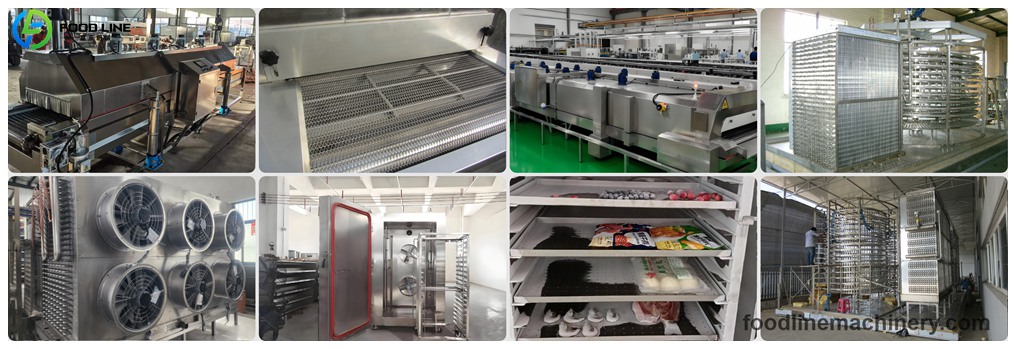
Industrial quick freezers, also known as blast freezers or rapid freezers, significantly enhance food quality and extend shelf life by fundamentally changing the way ice crystals form inside food products. Here’s a detailed breakdown of how they achieve this.
The Core Scientific Principle: Crystal Size Matters
When food freezes slowly (e.g., in a standard home freezer), water inside the cells forms large, sharp, needle-like ice crystals. These crystals puncture and rupture cell walls. When the food is later thawed, the damaged cells cannot hold their structure, leading to:
Drip loss (a pool of liquid/water)
Mushy texture
Loss of flavor and nutrients (which leak out with the liquid)
Industrial quick freezers solve this by freezing food extremely rapidly, typically in minutes rather than hours.
How Quick Freezing Improves Food Quality
1. Preservation of Texture and Structure
Smaller Ice Crystals: Rapid freezing creates numerous, tiny, uniform ice crystals that form inside the cells and within the intercellular spaces without damaging cell walls.
Result: When thawed, the cellular structure remains intact, preserving the original crispness (for vegetables), firmness (for meat/fish), or creaminess (for dairy).
2. Superior Flavor and Nutrient Retention
Minimized Drip Loss: Because cell walls are intact, vitamins (e.g., Vitamin C, B vitamins), minerals, and soluble flavor compounds stay inside the food rather than draining away.
Slowed Biochemical Reactions: Quick freezing rapidly lowers the temperature past the zone of maximum ice crystal formation (-1°C to -5°C / 30°F to 23°F), where enzymatic and oxidative reactions can degrade flavor and color.
3. Enhanced Color and Appearance
Slow freezing allows ice to push pigments (like chlorophyll in green beans or anthocyanins in berries) into concentrated pockets. Thawing creates pale, bleached areas.
Freezer burn is dehydration caused by water sublimating from the food’s surface. Quick freezing reduces the time for moisture to escape and forms a rapid crust, sealing the surface.
How Quick Freezing Extends Shelf Life
The principle extends beyond texture to microbiology and chemistry.
1. Rapid Passage Through the “Danger Zone” (Crucial for safety)
Bacteria multiply fastest between +4°C and +60°C (40°F–140°F). Even at 0°C (32°F), some spoilage organisms (e.g., Pseudomonas) can slowly grow.
Quick freezers drop the core temperature from ambient to -18°C (0°F) or lower in minutes, vastly reducing the time microbes have to reproduce before freezing halts metabolic activity.
2. Enzyme Inactivation
While freezing doesn’t stop all enzymes (some remain slightly active at -18°C), the rapid temperature drop minimizes their window to cause ripening, browning, or off-flavor development. (Many high-end processors blanch vegetables before quick freezing for full enzyme kill).
3. Lower Final Storage Temperature (Superior Cold Retention)
Quick freezers can achieve very low core temperatures (often -30°C to -40°C / -22°F to -40°F). This provides a large “thermal buffer,” allowing the product to stay safely below -18°C even during temporary temperature fluctuations in transport or storage.
Comparison: Slow vs. Quick Freezing
Feature
Slow Freezing (Home/Standard)
Industrial Quick Freezing
Freezing time
Hours (e.g., 6–24 hours)
Minutes (e.g., 10–90 minutes)
Ice crystal size
Large, jagged, destructive
Microscopic, smooth, non-destructive
Cell damage
High (ruptured cell walls)
Minimal to none
Thawed texture
Mushy, watery, limp
Firm, juicy, crisp
Drip loss
5–15% of weight
< 2% of weight
Flavor
Dull, “freezer taste”
Fresh-like, vibrant
Shelf life (at -18°C)
2–6 months (quality declines fast)
12–24 months (or longer)
Real-World Examples of Quality Improvement
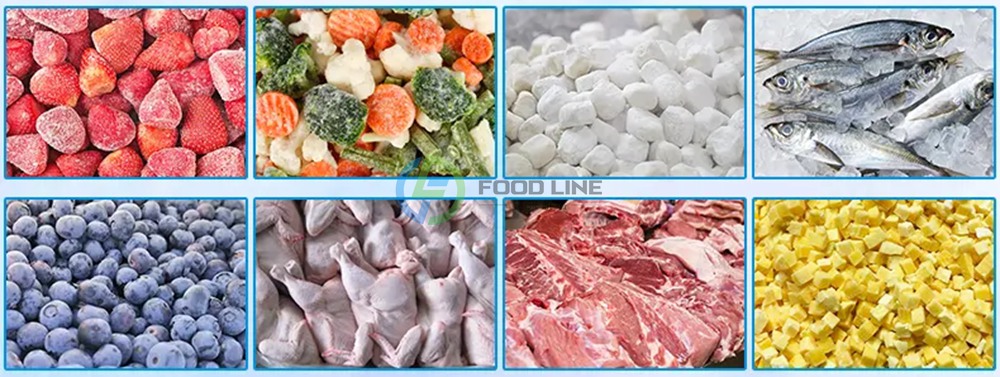
Berries (raspberries, blueberries): Quick-frozen berries hold their shape when thawed. Slow-frozen berries become a puddle of mush.
Fish (tuna, salmon): Quick freezing prevents protein denaturation, maintaining sashimi-grade texture and color.
Cooked meals (sauces, stews): Rapid freezing prevents phase separation (water separating from fats/thickeners), so the reheated meal tastes freshly made.
Dairy (ice cream): Quick freezing produces tiny ice crystals, creating a smooth, creamy mouthfeel rather than a gritty, icy texture.
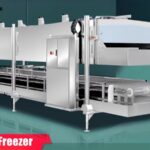
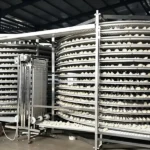
Industrail IQF quick freezer machine for sale
Important Limitations (What Quick Freezing Cannot Do)
Reverse spoilage: It cannot “repair” food that was already old, bruised, or contaminated before freezing.
Kill pathogens: It only stops their growth. Proper thawing and cooking are still required for safety.
Replace blanching: For many vegetables, blanching (brief boiling) is still needed to inactivate natural browning enzymes before quick freezing.
Conclusion
Industrial quick freezers improve food quality by preserving texture, flavor, and nutrients through the formation of microscopic ice crystals that leave cell structures intact. They extend shelf life by rapidly suppressing microbial growth and enzymatic activity, allowing frozen foods to maintain high quality for 12–24 months. This technology is why frozen fruits, vegetables, and seafood can often be superior in quality to “fresh” produce that has spent days in transit.