If you’re in the food processing business—or planning to enter it—choosing the right frying equipment can make or break your production efficiency, product quality, and profit margins. One of the most common questions buyers face is:
Should I invest in a batch fryer or a continuous fryer?
At first glance, they both do the same thing—fry food. But in reality, they serve very different production needs. This guide breaks down the key differences, advantages, and ideal use cases to help you make a smart, ROI-driven decision.
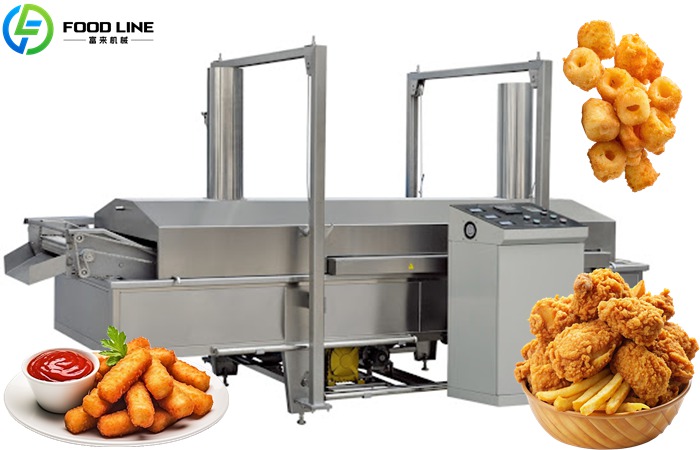
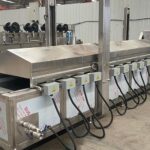
Continuous Fryer Machine
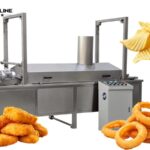
continuous fryer
What Is a Batch Fryer?
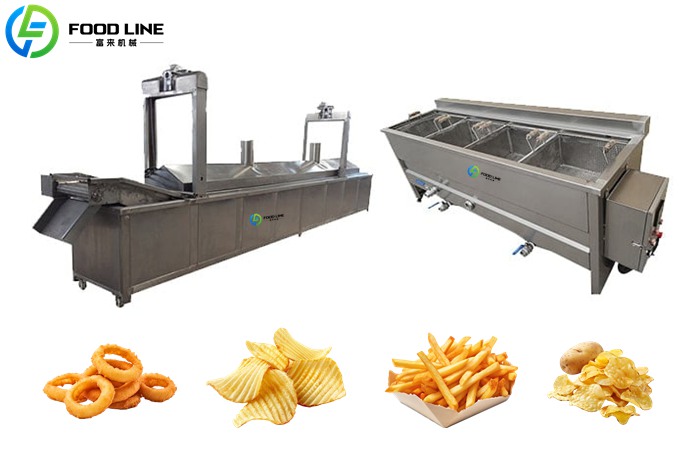
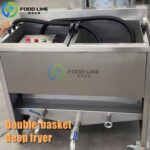
A batch fryer is designed to fry food in individual loads or “batches.” You load a specific quantity of product, fry it for a set time, then remove it before starting the next batch.
Key Features:
Operates in cycles (load → fry → unload)
Manual or semi-automatic control
Flexible for different recipes
Lower initial investment
Common Applications:
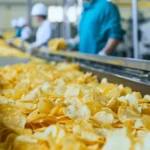
Potato chips
Fried chicken
Snacks and nuts
Small-scale food production
What Is a Continuous Fryer?
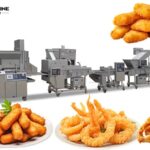
A continuous fryer is built for non-stop, automated frying. Products move through the fryer on a conveyor belt, allowing for uninterrupted production.
Key Features:
Continuous operation (no downtime between batches)
Automated temperature and time control
High production capacity
Consistent product quality
Common Applications:
French fries production lines
Large-scale snack manufacturing
Industrial food processing plants
Batch Fryer vs Continuous Fryer: Key Differences
Here’s a clear side-by-side comparison:
Feature
Batch Fryer
Continuous Fryer
Production Mode
Intermittent (batch-based)
Continuous (non-stop)
Capacity
Low to medium
High
Automation
Manual or semi-automatic
Fully automatic
Flexibility
High (easy to switch products)
Lower (optimized for one product)
Initial Cost
Lower
Higher
Labor Requirement
Higher
Lower
Consistency
Moderate
Excellent
Space Requirement
Compact
Larger footprint
Not sure which fryer to choose? Contact Foodline Machinery for help.
Advantages of a Batch Fryer
1. Flexibility for Multiple Products
If your business handles different types of foods, a batch fryer is ideal. You can easily switch between recipes without major adjustments.
2. Lower Investment Cost
Batch fryers are more budget-friendly, making them perfect for startups or small food businesses.
3. Easy Operation and Maintenance
With simpler structures, batch fryers are easier to clean, maintain, and operate.
4. Better for Small-Scale Production
If your daily output is limited, a continuous fryer may be overkill. Batch frying keeps things efficient without unnecessary costs.
Advantages of a Continuous Fryer
1. High Production Efficiency
Continuous fryers are designed for mass production. They can run for hours without interruption, dramatically increasing output.
2. Consistent Product Quality
Automation ensures precise control over frying time and temperature, resulting in uniform color, texture, and taste.
3. Reduced Labor Costs
Once set up, continuous fryers require minimal human intervention, saving on labor expenses.
4. Ideal for Industrial Production Lines
If you’re supplying supermarkets, fast-food chains, or exporting products, consistency and volume are critical—and that’s where continuous fryers shine.
Which One Should You Buy?
The answer depends on your business size, production goals, and budget.
Choose a Batch Fryer if:
You are a startup or small business
You produce multiple types of fried foods
Your daily output is relatively low
You want a lower upfront investment
You need flexibility in operations
Choose a Continuous Fryer if:
You operate a large-scale food factory
You focus on one or a few standardized products
You need high output and efficiency
You want to reduce labor costs
You aim for consistent, industrial-level quality
Real-World Buying Scenarios
Scenario 1: Small Snack Business
A local snack producer making chips, peanuts, and fried snacks in small volumes should go with a batch fryer. It offers flexibility and cost efficiency.
Scenario 2: Frozen French Fries Factory
A company producing tons of French fries daily for export should invest in a continuous fryer as part of a full processing line.
Scenario 3: Expanding Food Brand
If your business is scaling and demand is growing rapidly, transitioning from a batch fryer to a continuous fryer can significantly boost productivity.
Cost Considerations
While prices vary depending on capacity and configuration, here’s a general idea:
Batch Fryer: Affordable, ideal for limited budgets
Continuous Fryer: Higher upfront cost but better long-term ROI for large production
👉 Tip: Don’t just look at the purchase price—consider energy consumption, labor savings, and output capacity.
Final Thoughts
Choosing between a batch fryer and a continuous fryer isn’t about which one is better—it’s about which one is right for your business.
Batch fryer = flexibility + affordability
Continuous fryer = efficiency + scalability
If you’re just starting out, a batch fryer is a smart, low-risk entry point. But if you’re aiming for industrial-scale production, a continuous fryer is the clear winner.
Ready to Choose the Right Fryer?
At Foodline Machinery, we offer both batch fryers and continuous frying systems tailored to your production needs. Whether you’re launching a small snack business or scaling up to a full production line, our team can help you find the perfect solution.
👉 Contact us today to get expert recommendations, customized solutions, and competitive pricing.
FAQs
1. Can I upgrade from a batch fryer to a continuous fryer later?
Yes, many businesses start with a batch fryer and upgrade as demand increases.
2. Which fryer is more energy-efficient?
Continuous fryers are generally more energy-efficient for large-scale production due to optimized heat usage.
3. Is a continuous fryer harder to maintain?
It’s more complex than a batch fryer, but modern systems are designed for easy cleaning and maintenance.
4. Can batch fryers produce high-quality products?
Absolutely. With proper control, batch fryers can deliver excellent taste and texture—just with lower consistency compared to continuous systems.
Edith is a seasoned food machinery industry professional with over 10 years of hands-on experience in food processing equipment research, factory website operation, and technical content creation.